
At a Glance:
Location: Marino Ballena National Park, Costa Rica; Great Barrier Reef, Australia
Entity: Costa Rica Coral Restoration; GBR Biology (Reef Unlimited)
Systemic Problem: Tourist-led coral planting often fails due to genetic cloning, lack of monitoring, and warming oceans
The Response: Shifting tourism’s role from manual coral planting to funding lab-based sexual coral breeding, reef stabilization, Traditional Owner knowledge, and citizen science monitoring
The Costa Rica Coral Restoration education center is hidden amongst thick trees at the end of a bumpy dirt road in Marino Ballena National Park. One exterior wall of the building is painted in an expansive, colorful mural: the mangroves, parrots, and sunset above the shoreline and a menagerie of fish and coral reefs beneath the water. Inside the non-governmental organization’s (NGO) operational hub – crafted out of two refrigerated shipping containers that have been welded together – perspective is much less dramatic: A half-dozen large fish tanks filled with pieces of coral and circling clownfish line the wall. Lab equipment is heaped on shelves. The AC hums, and a brilliant blue light floods the room, emulating the feel of being underwater.
In comparison to the Instagram-worthy marketing images of tourist-friendly coral replanting efforts, this NGO is unglamorous and gritty, yet it takes a different approach to reef stewardship. “The idea when … Pablo [Piedra] first started this project with our other founders was, ‘Hey, we’re just going to work in the ocean, right?’ It’s cheap, it’s easy, we know it’s effective, and it’s done all over the world,” said James Jacob, laboratory director at Costa Rica Coral Restoration.
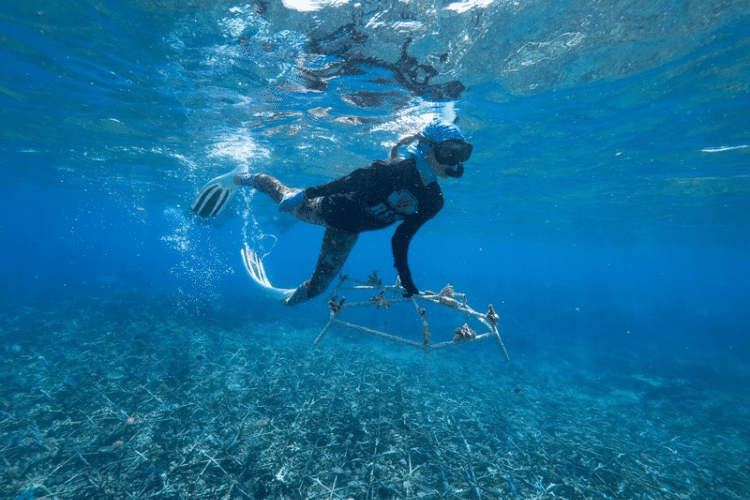
And it’s true: From Fiji to Key Largo, tourists are paying top dollar to dive at reef sites, tie coral fragments to wire frames, snap a selfie, and “save the ocean” in an afternoon. As people increasingly seek out ways to “give back” when they travel, feel-good activities like this flourish, even as they fail.
According to a 2022 review of 533 coral reef restoration projects in Indonesia, 84% didn’t have monitoring programs that took key features such as water quality, environmental suitability, methodology, and coral species into consideration. Coral fragments are sensitive to their surroundings, and unpredictable and radical sea conditions can cause bleaching and breakage. Additionally, asexual fragmentation produces clones, and if a heatwave hits a specific genotype, everything that’s been replanted can be completely wiped out. Sometimes the problem isn’t reef-related: A 2026 study of reef restoration efforts in Sanur, Bali, found planting coral fragments and building artificial reefs are failing because underlying problems like sediment runoff and wastewater discharge haven’t been properly addressed.
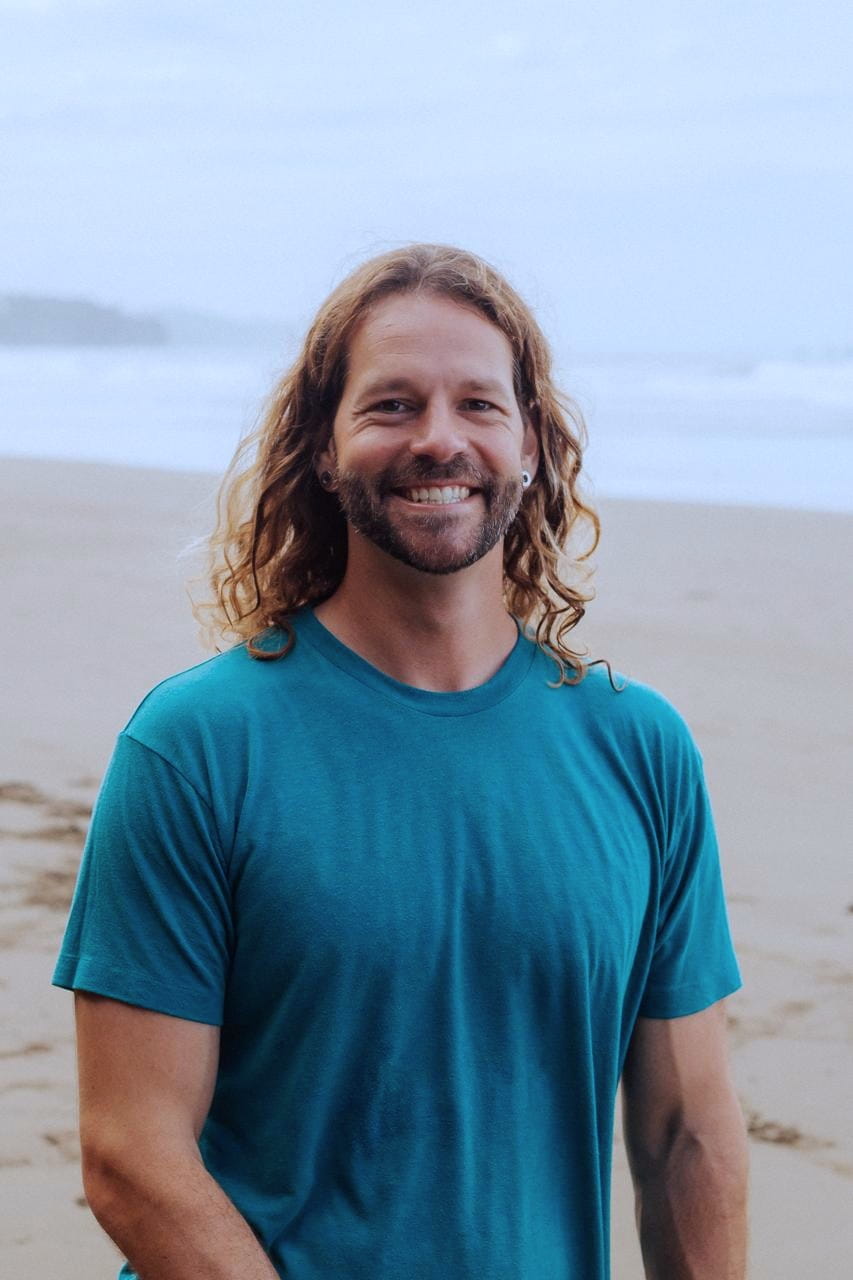
“We can be spending money on equipment here, not only for education of locals and people that are coming and going, but also on the next phase of the lab.” - James Jacob, laboratory director at Costa Rica Coral Restoration | Photo: James Jacob
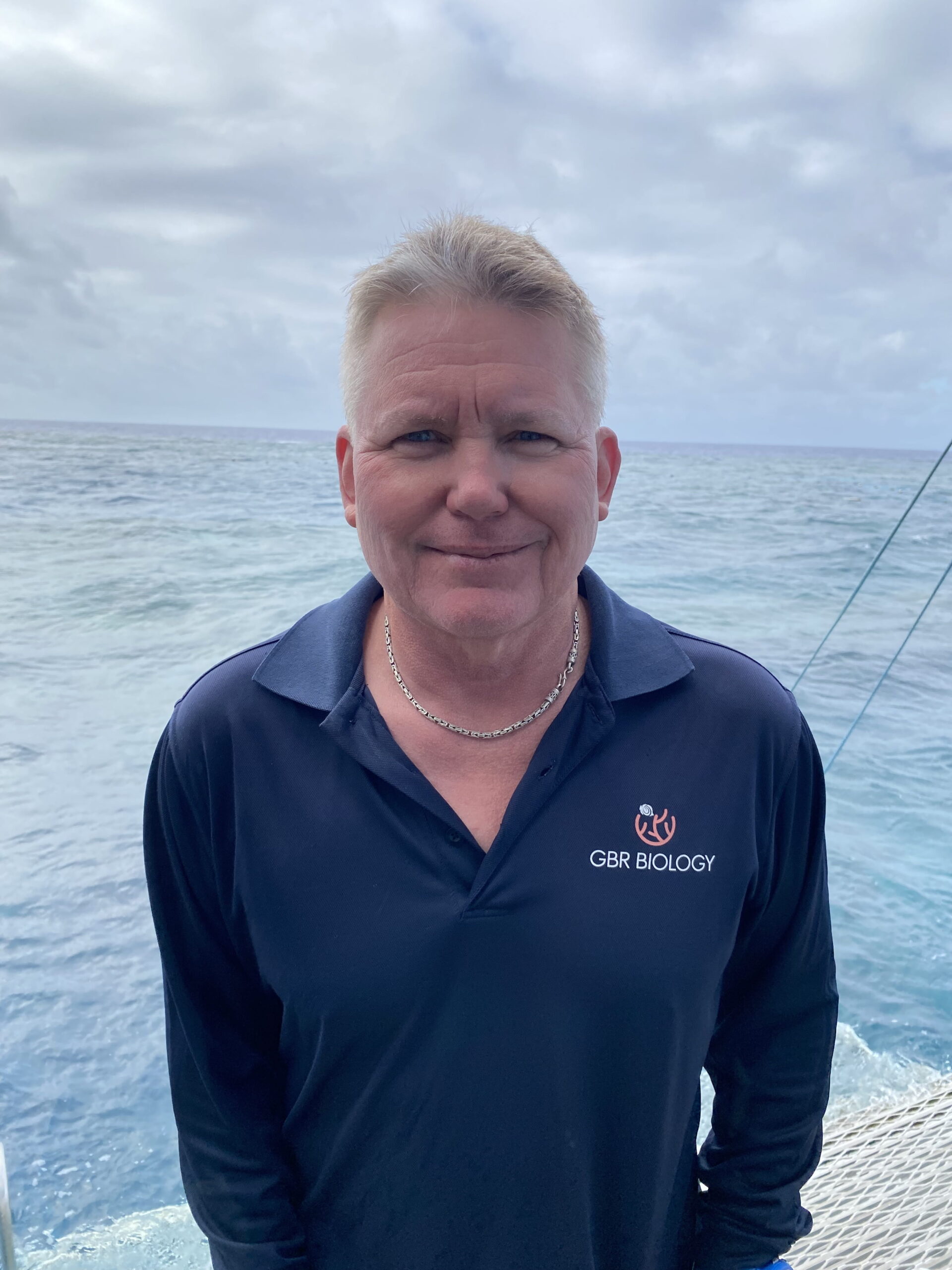
“We didn’t have any visitors to the reef for three and a half months in Cairns, and then it was very slow over a couple of years. But what everyone realized pretty quickly is when people don’t go to the reef, it kind of stops.” - Dr. Eric Fisher, biology manager and master reef guide at GBR Biology | Photo: Eric FIsher
As appealing as tourist-centric outplanting efforts are – and despite the alluring coastline right outside the lab’s doors – Costa Rica Coral Restoration now puts its resources elsewhere: Instead of spending $700 every week on boat fuel and operational costs to outplant coral at Isla del Caño, a small island and biological reserve, Jacob said, “we can be spending that money on equipment here, not only for education of locals and people that are coming and going, but also on the next phase of the lab.” And inside the lab, efforts are focused on finding and breeding resilient, genetically diverse male and female colonies to produce genetically diverse baby corals that can withstand the Earth’s changing conditions. Instead of participating in outplanting efforts, tourists (as well as schoolchildren and residents) are encouraged to visit, learn about this work, and donate toward the NGO’s efforts.
Across the Pacific Ocean and off the coast of Australia, Dr. Eric Fisher and the GBR Biology team introduce guests to the Great Barrier Reef. As the world’s largest coral reef system and living structure on Earth, the Great Barrier Reef is the polar opposite in size and scale of what’s found off the coast of Costa Rica, but Dr. Fisher is wrestling with the exact same biological truths. Operating as the dedicated science, education, and storytelling arm of Reef Unlimited – a company running five marine tourism brands out of Cairns and Port Douglas – GBR Biology consists of a dedicated team of 45 to 50 storytellers, educators, researchers, and conservationists. Predominantly university-trained marine biologists and First Nations culture guides, the team conducts research, initiates education, and runs tours along with a web of partners across the reef, which has experienced five mass bleaching events between 2016 and 2024 yet relies on tourism for its continued protection.
Marine research in open ocean waters is financially challenging, but using commercial tourism to help support ongoing monitoring efforts and resulting governmental regulation makes it viable. Reef Unlimited’s Reef Magic pontoon, for example, is an entry point for swimming and snorkeling as well as a fully functioning scientific lab and registered research center. “There are visiting researchers from Australia and around the world that come and use our lab,” Dr. Fisher said, “and, along with that, they also interact with our guests.”
Unlike some tourist-centric plant-it-and-leave-it coral intervention efforts, GBR Biology and its partners have placed more than 2,000 modular Reef Stars on the reef to transform unstable coral rubble beds into hard-coral ecosystems over the course of three to four years – something that normally takes 30 to 40 years. These efforts have yielded real victories: “The oldest Reef Stars on the Great Barrier Reef – they were nearly five years old – were spawning incredibly well. They even spawned better than some of the coral surrounding in the natural habitat,” Dr. Fisher said. This has allowed scientists to catch the wild larvae and reseed heat-damaged sections of the reef.
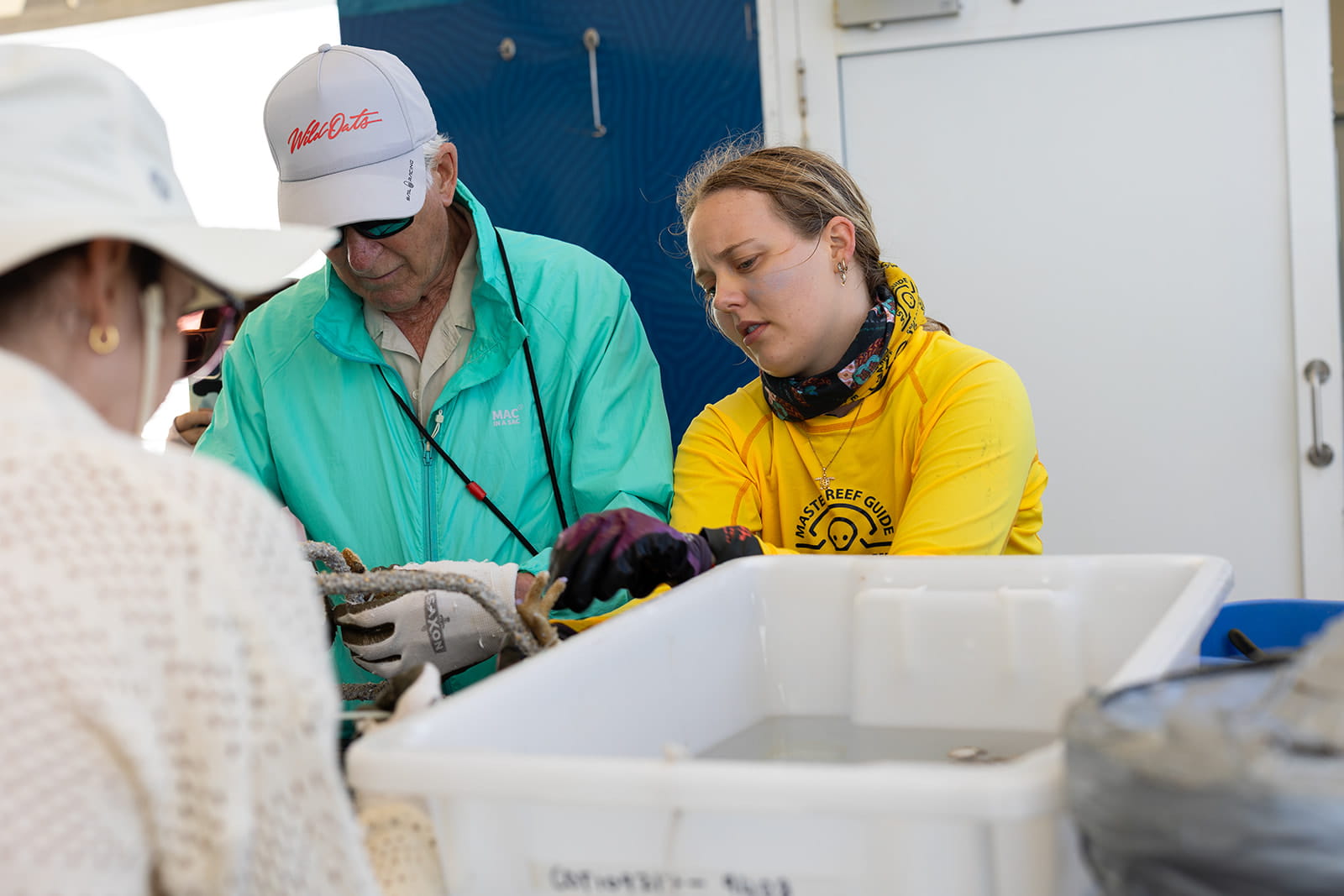
On reef recovery days, travelers help attach coral fragments to Reef Stars, which are then placed by GBR Biology and its partners to help stabilize coral rubble beds. | Photo: Harry Vick, Reef Unlimited
On designated “reef recovery days,” guests can help attach coral fragments to Reef Stars, but tourist involvement doesn’t stop there. GBR Biology’s wide breadth of activities includes cultural and biological guided snorkeling tours and access to an underwater observatory and glass-bottomed boats. In addition to conversations and hands-on experiences with researchers, snorkelers also play a vital role in collecting data for the Eye on the Reef citizen science program for the Great Barrier Reef Marine Park Authority (GBRMPA).
This is where the uncomfortable tension of reef stewardship comes into play: Long-haul commercial flights to far-flung destinations like Cairns emit a tremendous amount of carbon, directly warming the oceans that travelers are supposedly helping to save. “We’re not dancing away from [the fact] the reef’s got a problem. It’s definitely got a problem,” Dr. Fisher said. “It’s doing okay, but it needs help, you know? And the biggest help it needs is reduction in emissions.”
Yet, the empirical reality is that an unvisited reef is an unmonitored reef. “COVID was the first time the reef stopped still,” Dr. Fisher said. “We didn’t have any visitors to the reef for three and a half months in Cairns, and then it was very slow over a couple of years. But what everyone realized pretty quickly is when people don’t go to the reef, it kind of stops.” In the case of the Great Barrier Reef, every visitor pays an environmental management charge, which supports the GBRMPA’s wide array of outreach, research, monitoring, and educational efforts. Additionally, the sheer volume of daily visitors feeding snapshots into the Eye on the Reef app and through the Great Reef Census provides detailed, year-round observation data that academic institutions could never afford to gather on their own. Through guest photography and sightings logged on Reef Unlimited tours and citizen science platforms, scientists have recently identified whales not seen since 1989, tracked new manta ray corridors, and identified where crown-of-thorns starfish outbreaks are occurring. “Actions that tourism is doing on the reef can change policies on where we might set up special management zones,” he said.
Tourism is essential in holistic reef stewardship that goes far beyond alluring “plant a coral” activities; however, it isn’t a transient savior. It’s not up to tourists to “save” the reef but to play a role in the wider efforts to fund and support research efforts and permanent, local capacity. Through its partnerships and work with the Reef Cooperative, GBR Biology joins other organizations, including the Gunggandji Aboriginal Corporation and Dawul Wuru Aboriginal Corporation, to prepare the next generation of reef stewards. “We never lose sight of the fact that this is bringing together three big knowledge systems,” Dr. Fisher said. “You’re bringing in your Traditional Owner ecological knowledge. Tourism being there every day has some of the most continuous, fine-scale daily observations. And you’ve got this academic knowledge.”
From the simple double-wide operational center in Costa Rica to the dozens of boats teeming with scientists, First Nations caretakers, and tourists on the Great Barrier Reef, the complexity of regenerative reef stewardship can’t be contained with an afternoon photo op. Appropriately and meaningfully moving the needle on coral reef restoration requires a patient coalition consisting of diverse knowledge systems, skills, and capacities in which everyone plays a part.