At a Glance:
Location: Krakow, Poland
Entity: Krakow Urban Tours (independent, local tour operator founded by Tomasz Klimek)
Systemic Problem: High volumes of clean food waste generated by culinary tourism – compounded by commercial pre-ordering and cultural hospitality norms prioritizing excessive abundance – which typically ends up in landfills
The Response: A low-tech waste diversion protocol utilizing family-style service to preserve untouched surplus, packaging clean leftovers in paper containers, and mobilizing tour guides to drop meals into the city’s network of public community refrigerators
The table in the Krakow-based restaurant is cozy as guests pass heaping plates among each other, sampling the local cuisine. A guide leading the food tour braids personal anecdotes with stories about Poland’s history and culture. Appetites satisfied, the meal draws to a close, but – as is the case on many food tours – plenty of savory pierogi, juicy kielbasa, and smoky oscypek cheese still remain.
In most cases, these platters would be whisked away and leftovers discarded in the kitchen. But at Krakow Urban Tours, this is the part of the meal where all remaining food is boxed up and, after guests have moved on to other activities, donated to local community refrigerators for anyone to access.
Food tours occupy a notoriously challenging pinch point in the tourism ecosystem: Travelers increasingly seek out food-related activities as a way to learn about local cultures, and they expect to indulge generously on these experiences. But even as culinary tourism continues to grow at an average annual rate of 18% through 2035, food waste remains a stubborn problem as well.
In Poland, where the food service industry is responsible for about 12% to 14% of the country’s food waste, there is a cultural nuance that also contributes to the untouched placki ziemniaczane (potato pancakes) still left at the table: “In Polish tradition, you have to understand that we always give more than you can possibly eat,” said Tomasz Klimek, who founded Krakow Urban Tours 20 years ago. “You go to a Polish wedding, there’s an abundance of food. You go to a Polish party, it’s impossible to eat everything. In our culture, someone leaving hungry after a party would be the biggest insult for the host.”
Beyond factoring in cultural norms, it’s impossible to predict how much people will eat. However, for a tour to run smoothly, companies like Krakow Urban Tours pre-order food to eliminate downtime. “I think we can count on like ten fingers the number of times when everything disappeared,” Klimek said. “There’s always something left.”
Yet, since its inception, the company has accounted for this situation, building in ways to eliminate food waste by design. The tour uses family-style service, where food is delivered on communal plates from which guests serve themselves, rather than individually plated portions. This keeps any leftover food untouched and hygienic. Requesting takeaway containers was initially a foreign concept for the restaurants it frequented. Krakow Urban Tours persevered and was eventually able to get leftovers to go, which guides dropped off at churches and other community centers assisting people in need.
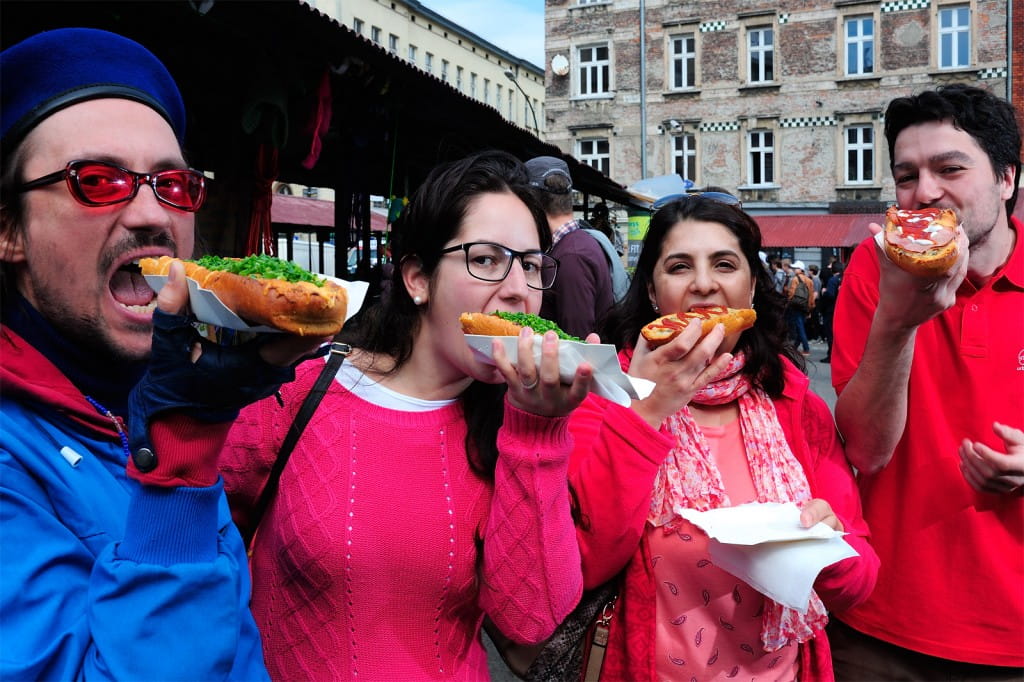
Culinary tourism is on the rise, which has the potential to contribute significantly to the global food waste problem. | Photo: Krakow Urban Tours
The COVID-19 pandemic normalized using to-go containers, and, in 2021, the city of Krakow opened its first three community fridges. Over subsequent years, additional ones have been added, and now a network of nine refrigerators spans strategic locations throughout the city. While there are guidelines tied to the initiative (raw meat and alcoholic beverages are prohibited, for example), residents are encouraged to contribute fresh, prepared, and labeled food for others. In some countries, liability presents a barrier for communal food distribution like this, yet there are nearly 1,600 community refrigerators located across Poland.
In Krakow, the fridges aren’t located in the city center, where tourists tend to be, so many visitors don’t know they exist. And, despite the over-indulgence food tourism often encourages, at the end of food tour meals, guests frequently express concern about potential food waste. Guides for Krakow Urban Tours are quick to talk about the waste diversion initiatives. “The guide calms the anxiety of people. He or she tells them, ‘Don’t worry, the food will not go to waste. We have this project, and we do this, and this, and this,’” Klimek said. “So, it appears in a very natural way. Even though the guides are trained and they know that they’re supposed to bring it up, it’s not artificial. It’s a very natural process because the story appears when the story is happening.”
The company’s guests aren’t involved in actually dropping food off at the community fridges; that’s left to the guides. At times, this can be challenging, given their locations, as guides may need to go out of their way to reach them. Sometimes they’ll find other solutions, like giving the food away to people experiencing homelessness they encounter on the street, Klimek said, but the food is always diverted in some way.
For Krakow Urban Tours, which runs three to five daily tours during peak season, this accounts for the equivalent of thousands of potentially wasted meals across the years. Multiply this by thousands of food experiences held around the world each day, and the cumulative amount of food waste created by day tours is staggering.
Food waste is a massive challenge across the tourism industry – one that UN Tourism recently addressed with the launch of its Recipe of Change initiative, which seeks to encourage operational and behavioral solutions in order to halve food waste by 2030. These solutions take many forms: integrating back-of-the-house technology that precisely calculates preparation needs, rearranging buffets to encourage smaller portion sizes, or composting food waste, for example.
The solution Krakow Urban Tours has adopted is low-tech and hyper-local to its situation. Yet, it works because the city has public refrigerators, community sharing is encouraged and unhindered by bureaucracy, and guides are willing to put in the extra work to ensure their neighbors have access to food. When the company’s guests gather around the table, eager to taste the local flavors, food waste isn’t an inevitable byproduct of Polish hospitality. Abundance of the feast simply continues its journey down the street when the fun comes to an end.