In This Article:
- The Regenerative Tourism-Solutions Connection
- Before Language, Focus on Mindset
- Tourism, the “Broken” System, and Adopting a Regenerative Narrative
- What is Regenerative Language?
- How to Apply Regenerative Language in Tourism Marketing Communications
- Additional Regenerative Tourism Language Examples
- Resources to Support Your Work
The way we talk about tourism shapes how we design it.
Consider this difference: “We aim to minimize our footprint” vs “we design experiences that actively restore ecosystems and strengthen local livelihoods.”
That shift in language reflects a shift in power, responsibility, and possibility.
Across cultures and generations, many societies have understood humans as part of living systems – not separate from them. Yet modern tourism language often frames people as inherently harmful and places as fragile backdrops to manage.
This is not an empowering narrative. It focuses on problems instead of potential and weaknesses rather than strength. It asks people to minimize themselves and the positive influence they can have on the communities they live in, the climate crisis, and the planet as a whole. It suggests we are separate from the ecosystem and environment in which we live and exist.
And for companies interested in supporting positive impact travel, it’s counter-productive.
It’s time to flip this narrative.
The Regenerative Tourism-Solutions Connection
There’s no question about it: Regeneration is one of the hot topics cutting across sectors and trends today. Regeneration is the process of rebuilding or revitalization within a holistic ecosystem with an eye toward renewal and recovery.
Within the tourism ecosystem, regeneration is generally considered to be the process of leaving a place better. However, simplified definitions of “regenerative tourism” still inappropriately center tourism by placing travelers’ interests and expectations about “doing good” above local needs. “Regenerative tourism” should reflect a systems approach in which tourism plays a role, but not the leading one. Tourism becomes regenerative when it integrates into the wider social, ecological, and economic fabric of a place.
We often focus on what tourism has done wrong or only on how its benefits are transactional. A regenerative approach to tourism considers how tourism as a whole (as well as singular travelers) become meaningful contributors to the ecosystems in which they exist. It also leans into a solutions-oriented outlook while supporting places, communities, and nature through positive impact travel.
Before Language, Focus on Mindset
In today’s rush to jump on trends, respond to perceived desires, reach target audiences, and feed the content creation monster, many travel brands rush into tourism marketing communications without realizing there’s internal work to do. There is a circular action-intention loop at play when it comes to regeneration. Embracing a regenerative mindset is supported by using regenerative language and narratives, but you shouldn’t use regenerative communication if it isn't genuine and doesn’t reflect your brand’s values and intentions.
So, what does a regenerative mindset look like internally?
Scarcity vs. Abundance: Room for All of Us
Business strategy has long relied on scarcity: Resources are limited, so competition is not only expected but inevitable. Success requires taking a larger share, and growth in a limited space is the only path forward.
It is true that scarcity is, at times, very real: Land, water, food, and other resources are finite. However, while resources may be finite, an abundance outlook couched within a regenerative mindset also acknowledges that relationships, knowledge, and creativity expand possibilities rather than restrict them. This is a shift that encourages asking questions like “what is the potential…?” and “how do we design for…?”
Examples:
- “With so many tour guides operating here, we’ll never get enough business.” > “All of the tour guides here have a unique perspective, and there are enough visitors for all of us.”
- “If we share our suppliers, there won’t be enough to go around.” > “By coordinating with our suppliers, we can strengthen local capacity and create reliable demand for everyone.”
Competition vs. Co-Creation and Collaboration: Let’s Work Together
Competition encourages innovation and progress through rivalry. Achieving an advantage through competition is a zero-sum game in which someone wins and someone loses – whether that’s between companies or within companies.
Meanwhile, co-creation leverages the skills and abilities of everyone. Value creation occurs when people collaborate and combine their efforts and skills. Ultimately, everyone “wins,” often on a much larger scale because everyone works together.
Examples:
- “We need to outperform neighboring destinations to attract more visitors.” > “We can collaborate with neighboring destinations to create regional experiences that benefit us all.”
- “Other tour operators are our competition.” > “Other tour operators are potential partners in strengthening the overall visitor experience.”
Individual Sacrifice vs. Collective Power: Combining Our Strengths
Many of the sustainability and climate challenges we currently face come down to how individualism has been pitted against collective power. The most famous example is how BP framed the creation (and, therefore, the reduction) of carbon emissions as the responsibility of individuals.
Through this narrative, people have been told how to contribute less to global problems but not necessarily how they can be most effective in helping to fix them. Broadening that perspective, we can focus not on how one person can overcome a massive challenge (like reducing global carbon emissions) but on how we can use collective power to work toward a shared goal.
Examples:
- “It’s up to me to fix the sustainability challenges in my company.” > “Together, our coordinated actions can shift the entire tourism system.”
- “Our certifications prove our business is responsible.” > “Our collective commitments create a culture of responsibility across the destination.”
Human v. Nature vs. Humans as a Part of Nature: We Are One
The narrative around how people relate to and with nature is introduced at an early age (“don’t get dirt on your clothes”) and is steadily reinforced throughout our lives and in the workplace (“don’t use too many natural resources”). Yet, this divide doesn’t acknowledge the interconnectedness we share within a wider ecosystem context. What humans do impacts nature, and how nature exists impacts humans. Needless to say, most of us have a lot we can learn from Indigenous knowledge and the reciprocity of these relationships.
There have been movements in recent years to more accurately describe these relationships because language matters. This includes a campaign to change the definition of nature so it encompasses humans. There’s also been greater scrutiny on the concept of wilderness, which currently fuels a nature/culture dualism suggesting humans are unnatural and separate from nature rather than a part of it.
Examples:
- “Tourism impacts nature, so we need to protect it from people.” > “Tourism is part of living ecosystems. When we travel thoughtfully, we strengthen the reciprocal relationships between people and place.”
- “We need to manage natural assets.” > “We are in relationship with the land, and our actions shape its future, just as it shapes ours.”
Tourism, the “Broken” System, and Adopting a Regenerative Narrative
Looking at the wider societal picture and noting how unfair, unjust, unsafe, unhealthy, and inaccessible things are, it’s fairly common to hear people say “the system is broken.” However, the system isn’t broken. It produces exactly what it was designed to produce: growth measured primarily by financial return, often at the expense of ecological and social wellbeing.
This is why adopting a regenerative approach requires a systemic change – but that also means we need to abandon the language propping this system up as well. If your company adopts regeneration as a guiding value, then keeping transactional, hierarchical language in place when communicating fails to recognize tourism’s full potential in this capacity.
We also often fail to communicate to our staff and travelers about how and why their active presence is a good thing. “Regenerative tourism” requires active presence – not passive consumption. This means engaging with people, ecosystems, and economies in ways that contribute rather than extract.
This is where the shift from the internal mindset to adopting a regenerative narrative and language begins to take place. Here are some questions to support that shift:
- How can I matter?
- How can we make our presence be felt in as much of a positive way as possible?
- How can we take up space and actively participate to ensure a better world will emerge?
What is Regenerative Language?
To support a regenerative approach to tourism, it’s also important to adopt a narrative and language supporting this work. Regenerative language is communication that makes agency visible and frames tourism as a contributor to living systems and not merely a reducer of harm. Instead of staying stuck on scarcity and damage, it focuses on holistic vitality and inherent capacity. And, beyond values alignment, regenerative language also builds trust, strengthens brand credibility, and differentiates your company in a market increasingly skeptical of greenwashing.
Reframing the way we use language matters because it influences our perspective – and therefore our roles and responsibilities – as individuals, tourism practitioners, collaborators within communities and the greater tourism ecosystem, and global citizens of the world. Adopting this language catalyzes a positive shift in how we approach tourism beyond “doing less harm” or even “doing good.”
Reconsidering Current Tourism Language and Narratives Through a Regenerative Lens

With these regenerative language features in mind, consider the current way we communicate about tourism and in travel-related contexts. Transactional language reinforces a one-way, top-down, linear form of operation and interaction. If you’re not convinced, consider common terminology and narratives – and how we can shift our thinking:
- Industry > Ecosystem
- Tourists/travelers > Guests
- Locals/local residents > Hosts
- Strategic planning > Co-creation/emergence
- Traveler-/tourism-centric > Travelers/tourism as an integrated part of the societal fabric within the community (a part of the whole rather than the whole with the community playing a bit part)
- Wealth as money, stuff, and goods > Wealth as richness of joy, friendships, security, and confidence in a viable future
These shifts emphasize relationship over transaction – not hierarchy. In other words, tourism is not just a transaction of money for experience (and vice versa), but rather a way to foster relationships built on mutual respect for a place, the people who live/play/work in that place, and the people who visit that place.
How to Apply Regenerative Language in Tourism Marketing Communications
To underscore an important point, this isn’t just a change in terminology. If your company embodies regeneration as a practice, the way you talk about your work will likely naturally shift as well. This is a shift that matters and should show up in website copy, impact reports, social media posts, tour briefings, staff training, and tourism marketing campaigns.
Nonetheless, while the language matters, the action and intention matter more. Don’t let this become another example of jumping on the buzzword bandwagon.
Use Active Voice
Clearly state who does what in your communications. Using passive voice hides power while active voice reveals agency. Prioritize the active voice to clearly state relationships, assign responsibility, and uphold accountability without blame. This means naming actors, naming systems, acknowledging participation, and recognizing shared responsibility. Regenerative language requires visible actors, because if no one shaped the system, no one can reshape it.
Examples:
- “Residents felt excluded from tourism planning.” > “We designed tourism strategies without including resident voices in decision-making.”
- “Cultural traditions have been commodified.” > “Tour operators and marketers packaged cultural traditions in ways that prioritized sales over community respect and meaning.”
Additional Regenerative Tourism Language Examples
“We must minimize our footprint on nature.” > “We are participants in living systems; our presence can contribute to ecological renewal.”
“This destination lacks infrastructure and skilled workers.” > “This destination has strong cultural knowledge and local networks that can guide infrastructure development in ways that reflect community values.”
“Locals need training to meet global standards.” > “Local expertise and lived experience are valuable foundations for shaping tourism standards.”
“We have to protect our market share.” > “We can grow the value of the whole ecosystem by aligning our efforts.”
“If we share our sustainability practices, we lose our edge.” > “Sharing our sustainability practices raises the standard for everyone.”
“If we work harder than everyone else, our business will succeed.” > “When we align our strengths as a network, the entire destination thrives.”
“Tourists are destroying this place.” > “Visitors can be powerful allies in regenerating this place.”
“Our goal is to leave no trace.” > “Our goal is to leave places better than we found them.”
Lead with Asset Framing
When it’s not trying to minimize its presence, tourism is often centered as a savior in places it operates. It becomes the protagonist and hero while locals are bit players who are “saved” by the benefits of travel. Flip the script through asset framing, which is the practice of defining people and communities first by their aspirations, abilities, and contributions, and then by the challenges they face.
In a way, this counteracts the idea that we need more transparency about reality and challenges in the tourism context. And, it’s true, travel stories have historically plastered a veneer on places so they are palatable and pleasant for visitors. However, asset framing, a framework developed by Trabian Shorters, isn’t about pretending barriers, challenges, and problems don’t exist; it’s about not letting them define the story. Narratives leaning on tropes like “vulnerable” and “at-risk” may sound honest and compassionate, but they strip people of their dignity and agency – problems to be solved rather than partners in co-creating change. When we start with what is wrong, we reinforce a narrative of deficiency.
Examples:
- “This community is poor but happy.” > “This community has unique cultural strengths and ecological knowledge passed through generations.”
- “This region is underdeveloped.” > “This region holds untapped cultural, ecological, and relational wealth.”
Focus on Positive Efficacy
Self-efficacy is the belief that your actions make a difference and your efforts can create change. Positive self-efficacy frames have largely been absent from sustainability and climate conversations, in particular, because emphasis has been on problems, negative imagery and messages, and stories focused on powerlessness instead of solutions, hopeful stories, and messages focused on action and engagement. Yet, self-efficacy frames highlight possibility and potential, and, in this context, an opportunity to empower people to move from being passive travelers to actively engaged global citizens through travel.
Examples:
- “There’s not much an individual traveler can do.” > “Each traveler shapes demand – and demand reshapes the system.”
- “We hope guests behave responsibly.” > “We invite guests to participate in stewardship efforts during their stay.”
Be Specific

Be mindful of using nouns that stand in for both adjectives and nouns. For example, the tendency to say we need to reduce our footprint isn’t clear; rather, we need to reduce our carbon footprint. Similarly, it is common to use words like “impact,” “use,” and “consumption” with a negative connotation without clarification. In fact, a regenerative lens suggests we can have a positive impact, use with intention, and responsibly consume.
Clarity restores credibility, and it also opens the door to targeted action.
Examples:
- “Tourism uses too many resources.” > “Peak-season hotel operations increase freshwater extraction from local aquifers.”
- “We’re reducing our footprint.” > “We are reducing our carbon emissions from transportation and energy use.”
Avoid Fear and Shame
Storytelling has a tendency to sit on the side of doom and gloom, yet seeding hope and optimism helps people escape the fatalism spiral of “never enough” and “doesn’t matter.” We want people to embrace joy in taking action, but it’s hard to take action from a place of fear or guilt. Rather, we want to extend an invitation and agency to take action.
Examples:
- “You should feel guilty for flying.” > “Let’s explore ways to make your travel contribute more than it takes.”
- “Don’t be an irresponsible traveler.” > “Let’s brainstorm practical ways to align your travel choices with your values.”
Think in Circular Systems
Regeneration is a circular concept rooted in renewal and restoration. The circular economy isn’t another word for recycling; it’s an economically viable solution offering value. Use this idea to reframe aspects of tourism that are generally viewed from a linear perspective.
Waste, for example, is often framed as something disgusting that needs to be discarded. But, in a circular economy, products are not simply discarded at the end of a linear life cycle; rather, consider how waste is a resource able to create something else.
Examples:
- “We’re working toward zero waste.” > “We’re designing systems where materials continuously cycle back into use.”
- “Food waste is a major problem.” > “Food scraps become compost that nourishes the farms supplying our kitchen.”
Highlight Solutions and Empower Action
Embracing the full narrative of a place doesn’t require sugarcoating or over-emphasizing challenges. There is a balance here, but at the heart of this is the question of what – if anything – should travelers know and do. Who are the changemakers? How can tourism support them? How can travelers use their presence and resources to meaningfully contribute to this place?
This is a chance to help people shift their mindsets not only when they travel but in their day-to-day lives as well. Extend their thinking beyond their vacation. Living and working in a regenerative ecosystem isn't just about minimizing negative actions and decreasing extraction away from home. It also involves living and acting mindfully and with intention every single day.
Examples:
- “We encourage you to be a responsible traveler.” > “Here are three ways you can contribute during your stay: stay longer, buy locally, and participate in stewardship.”
- “This destination is struggling with overtourism and crowding.” > “We can encourage visitors to choose off-peak travel and community-led experiences that distribute economic benefits.”
Are you ready to take action?
Start with these resources.
Resources Beyond Rooted

BOOK
Braiding Sweetgrass: Indigenous Wisdom, Scientific Knowledge, and the Teachings of Plants
Robin Wall Kimmerer
Kimmerer is both a botanist and member of the Citizen Potawatomi Nation. She brings both of these identities to this book, which is an invitation for people everywhere to come into relationship with the Earth.
ACADEMIC PAPER
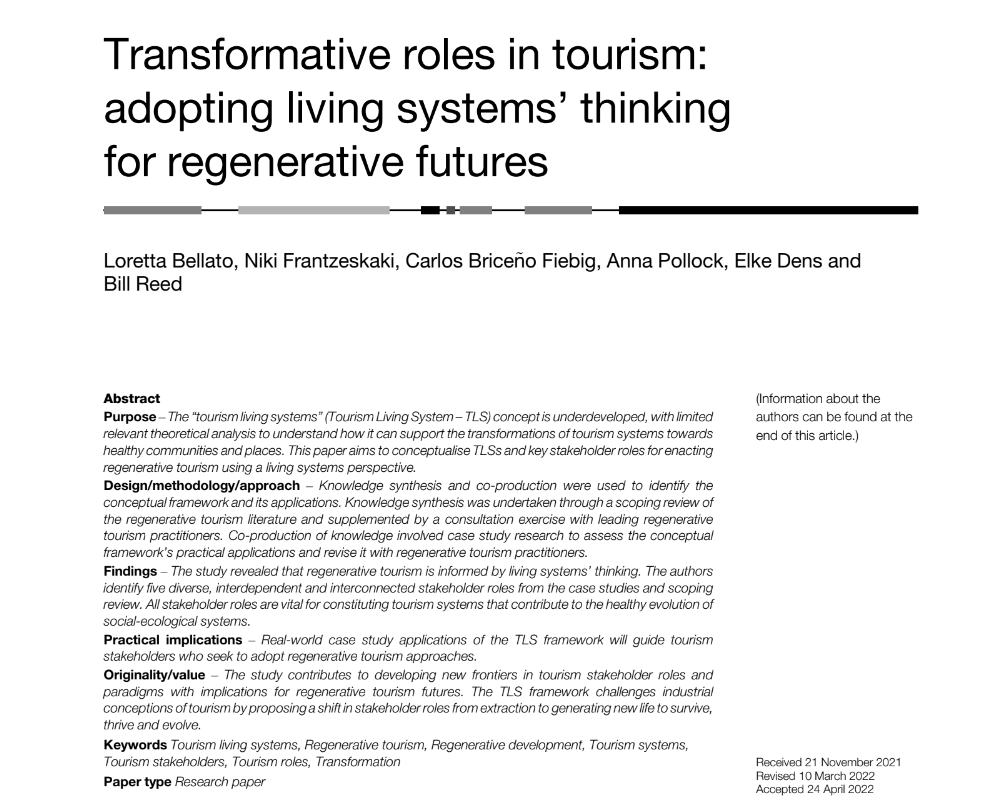
Transformative roles in tourism: adopting living systems' thinking for regenerative futures
Loretta Bellato, Niki Frantzeskaki, Carlos Briceno Fiebig, Anna Pollock, Elke Dens, and Bill Reed
This academic paper offers clarity on what a tourism living systems framework looks like, the role stakeholders have in such a framework, and real-world applications for destinations interested in adopting regenerative tourism approaches.

GUIDE
Stories to Save the World
Futerra
Climate change is the story of our present day, yet we've not yet done a great job of sharing that story at a scale that catalyzes action and change. There is a great need to use the magic of stories to weave a world of solutions underpinned by science. This guide offers 10 frames from which we can shape the climate narrative.