
This article was originally published in March 2023. It has been extensively rewritten and republished to reflect the present day.
In the years since the tourism industry committed to “building back better,” global events have altered decision-making and tech advances have curtailed climate commitments. The tourism environment has fundamentally changed in only a few short years, and economic stability combined with ongoing post-pandemic recovery has the industry chasing “high-value” travelers.
We talk a lot about the high-value traveler within the tourism ecosystem. In doing so, we largely fixate on value from a monetary perspective. Therefore, a high-value traveler is a person who has the potential to spend a lot of money while visiting a destination.
Despite the increasing challenges facing tourism, 2025 visitor spending and visitation hit all-time highs in many parts of the world. The financial impact is extraordinary and remains one of the key indicators of “success.” In fact, money is also one of the tools gatekeepers use to keep these massive traveler numbers in check. With more destinations implementing or increasing visitation fees, and price increases on everything from airline tickets to restaurant meals, one could argue leisure travel is becoming more elitist by the day.
In other words, a combination of industry action and external factors often makes it possible for only “high-value” (financially flush) travelers to go on holiday. More money, fewer people: It sounds like the ideal scenario.
But, how does financial prowess equate to benefit for communities and nature?
This is the spending paradox the tourism industry now faces, and one with which it must reckon: High spend does not equal high positive impact. High value isn’t only about how much money someone spends, but by where that money sticks and the ongoing ripple effects of a visitor’s presence.
Deconstructing Elitism: Reconsidering Budget Travel
Once upon a time, the “budget traveler” or “backpacker” was ubiquitous – and largely celebrated. Toting backpacks, trading transportation hacks, sleeping in hostels, meeting fellow travelers while cooking in the kitchen, and taking advantage of “off hours” and cheap drinks, these people sought out strategies for “traveling the world on $10 a day.” Entire brands were built around stretching every last cent to the greatest extent possible.
And yet, there’s dissonance that needs to be reconciled here: Low-cost travel is not necessarily of low value. Conversely, those willing to pay a high price don’t necessarily embody high ethics.
Many travel brands are afraid that, if they don’t attract wealthy clientele, their businesses will die. But a business model relying on the fleeting whims of the rich is inherently fragile because it’s built on money. Attracting people for financial reasons has the potential to drain the life out of a place. On the other hand, a business model built on shared values is far more resilient. The real risk, then, isn’t low spend but minimal respect, which might ultimately provide an overall low value for communities.
Consider the following scenario: A budget backpacker might visit for three weeks, all the while staying at a $30/night, locally run guesthouse, using a neighborhood tuk-tuk to get around, eating at “hole-in-the-wall” family eateries, and shopping at the neighborhood market. Alternatively, the wealthy traveler might zip in for a long weekend and book a suite for $1,000/night at an all-inclusive resort, where they spend most of their time.
While the high-end resort guest might spend more, the economic leakage – money flowing out to foreign investors and global supply chains – is often significantly higher. Additionally, the budget traveler has a smaller carbon footprint. The wealthy traveler often pays for predictability and convenience, and convenience is almost always standardized and globalized. The budget traveler often pays for access, and access is almost always locally oriented.
Budget-shaming people by writing off those who spend less money ignores the regenerative potential of slow, immerse, and accessible travel. It overlooks the real local economic impact of tourism. If we equate good or desirable travel with expensive – or financially generous – travel, we effectively gatekeep all travelers from being able to participate in a tourism model that prioritizes local autonomy, environmental conservation, and community wellbeing. Even as the tourism industry creates barriers around places and experiences in order to preserve their integrity, it must acknowledge the importance of making meaningful travel experiences available to those who can’t afford or access them.
Shifting the Perspective on Value
A fixation on monetary value makes sense. The financial benefits of tourism are undeniable. Plus, visitor spending is easily quantifiable and a straightforward (and obvious) metric of success.
Nonetheless, the potential of high-value travelers shouldn’t stop there. A search on the term “high-value travelers” notes they are likely to spend more as well as stay longer and disperse beyond the hotspots. Additionally, they’re motivated by nature, wildlife, aquatic, food, and hands-on experiences. To fully tap into the potential of these visitors, the tourism industry must look beyond finances to behavior when it seeks to attract people who benefit a destination.
To consider this from a different perspective, simply add an additional letter: values. “Values” are defined as principles or standards of behavior. In this context, valuing something means believing it is worthy, important, and deserving. Unlike the industry-standard “high-value” traveler defined by spend, a high-values traveler is defined by their qualitative alignment with a destination’s social, ecological, and cultural integrity. These travelers venture forth with a sense of curiosity, interest, and respect. This offers a more sustainable, regenerative, and genuine avenue through which to attract potential travelers.
Looking at high value from this perspective, let's set finances to the side for a moment and consider how this reflects current ways of defining ideal travelers. High-values travelers might not be able to afford the priciest hotel or book the multi-day tour, but they are valuable because they ask questions, seek out meaningful experiences, and travel with an open mind.
Often, these travelers are also easier to host. A high-spend, low-values traveler may be more likely to demand “home-like” comforts (like air conditioning) whereas a high-values traveler accepts local limitations as part of the experience. This means the high-values traveler also represents lower infrastructure costs because they don’t require the massive energy and water subsidies high-end luxury developments often demand. To be clear, there are high-values luxury travelers and high-values budget travelers; the difference isn’t in the amount of money they spend but in the way they act and behave.
Because the tourism industry has been so entrenched in the quantitative, monetary definition of success, shifting perspectives requires effort. Clearly connecting with ideal travelers defined in this way requires destinations to understand their own values. Traditional KPIs like number of arrivals and dollars spent can flag, but the values of a destination – those aspects deeply defining and driving a place – remain steadfast. They are the North Star. What would it look like for visitors to align with those values? Where and how can people both engage in memorable holiday experiences and offer added value to the greater community ecosystem?
Even though these values lie at the heart of a place, holding them front and center can be hard. It challenges the tourism industry’s primary measurements of success. Measuring values alignment is qualitative – something that can’t easily be captured in a graph or “proven” to stakeholders. Yet, “success” should be dependent on continued holistic alignment and not simply by attracting financially high-value travelers who spend more.
Feature | traditional "high value" | regenerative "high values" |
|---|---|---|
Primary Metric | Quantitative (total spend / daily rate) | Qualitative (alignment / net positive impact) |
Traveler Goal | Convenience, exclusivity, "home-like" comfort | Access, connection, place-based reality |
Economic Impact | High gross spend; often high leakage | High local retention; dispersed ripple effects; "sticky" money |
Resource Strain | High (demands infrastructure adaptation) | Low (accepts and respects local limits) |
Success Indicator | Growing arrivals and high-spend requests | Community well-being and ecosystem health |
Narrative Role | The traveler is the main character | The place and people lead the story |
How to Attract the High-Values, High-Value Traveler
Spending power may be a tool, but behavior is the real impact. Once a destination has committed to expanding success beyond monetary value to values, it’s time to focus on attracting people who believe a place and its people are important and worthy of respect.
Audit Your “Vibe”
Take a hard look at public-facing marketing and communications. There should be alignment between your values and messaging about your destination. Does your imagery only show experiences that require a large financial lift, or does it show connection? Do your stories feature exclusivity, or do they center people? This marketing audit isn’t about diluting or “dumbing down” your brand, but rather trusting your audience to appreciate its complexity.
Accurately reflecting who a travel brand wants to attract is the only way for the desired people to feel like they are welcome. Remember: Being “everything to everyone” might feed the financial bottom line, but it’s a recipe for attracting low-value, high-impact crowds that don’t sustainably support your community or align with your values.
Use Strategic Transparency
There is an understandable tendency for destinations to put their very best on display in order to attract people – the aesthetically pleasing landmarks, well-known attractions, and appealing features. It’s an easy and comfortable cognitive shortcut from inspiration to booking if all the predictable pieces fall into place. However, this is rarely a destination’s complete picture.
Instead of only sharing the highlight reel, communicate the more comprehensive story. Move away from pristine or empty landscapes that serve as backdrops toward more lived-in and community-centric visuals. Incorporate stories about real people doing real things. Embrace the perfectly imperfect and real beauty of a place – and connect with the people interested in grappling with this complexity while traveling.
Redefine Traveler Expectations
With a regeneration tourism approach, the desired traveler is the one who respects community norms and expects to contribute meaningfully to the communal fabric – not the person who believes they dictate the rules. This isn’t a person who expects to receive special service, but someone who offers appropriate respect.
The typical tourism narrative has long centered travelers as the main characters – what they want to see and experience, how their presence is non-negotiable in a destination’s success. This has had the unintended consequence of centering travelers within the context of a place to the detriment of the people who live there. Instead of centering the traveler, let the place and people within it lead the storytelling. Use this as an opportunity to realign traveler expectations during the travel planning stage and upon arrival.
Offer Diverse Entry Points
Even if travelers aren’t flush with cash, they can still offer incredible value to a place and be very much aligned with its values. Attracting high-value travelers who can afford to dine in restaurants sourcing regional ingredients, hire local guides and pay for excursions, and stay in accommodations owned and run by residents is ideal, but not accessible for everyone. If and when possible, offer one-off lower-cost, high-impact community workshops; promote low-footprint experiences like walking trails or self-guided tours that disperse income to many communities or neighborhoods; and offer tiered fee structures at attractions and for experiences with daily allotments.
It’s also worth noting that expensive travel experiences exclusively attracting high-value travelers don't just gatekeep by class, but often by race and geography. This further entrenches the “Global North vs. Global South” power dynamic in tourism. To make travel more accessible to everyone, this is also an invitation for tourism professionals to advocate for looser visa restrictions, especially for those who intend to travel within a single destination for an extended period of time.
Taking the concept of high-value accessibility one step further, tourism fees should be used to fund reparations and pay livable wages to Indigenous people and other exploited communities both within the travel sector and beyond. Additionally, service providers owned by historically marginalized communities should receive priority access to funding, training, and opportunities in order to help break down boundaries of elitism within the industry.
From Extraction to Exchange
Though the days of bonding together over “building back better” feel like they are lightyears behind us, the sentimentality of creating a better tourism model should still be a beacon for future endeavors. To achieve this, we have to stop measuring success by the size of the wallet and start measuring it by the depth of the impactful footprint.
The tourism industry may be making incremental progress in departing from the dollar-driven traveler, but the question remains whether we’ve gone far enough to define and attract travelers who are truly valuable. This additional shift in perspective – from high (financial) value to high (behavioral) value – has the potential to nudge the industry even closer to the radical reinvention that is long overdue.
Are you ready to take action?
Start with these resources.

Resources Beyond Rooted
REPORT
Destinations at Risk: The Invisible Burden of Tourism
Travel Forward, Cornell University’s Centre for Sustainable Global Enterprise, and EplerWood International
This comprehensive report details the unrealized burdens travelers place on destinations (such as waste management and increased cost of living) along with tools and systems to address them.

GUIDE
The Anti-Greenwash Guide for Agency Leaders
Creatives for Climate
An important resource for anyone developing sustainability-related messaging, this guide explains what greenwashing is and how to avoid it with a helpful "how not to greenwash" checklist. It also contains several case studies illustrating what greenwashing looks like in practice.
REPORT
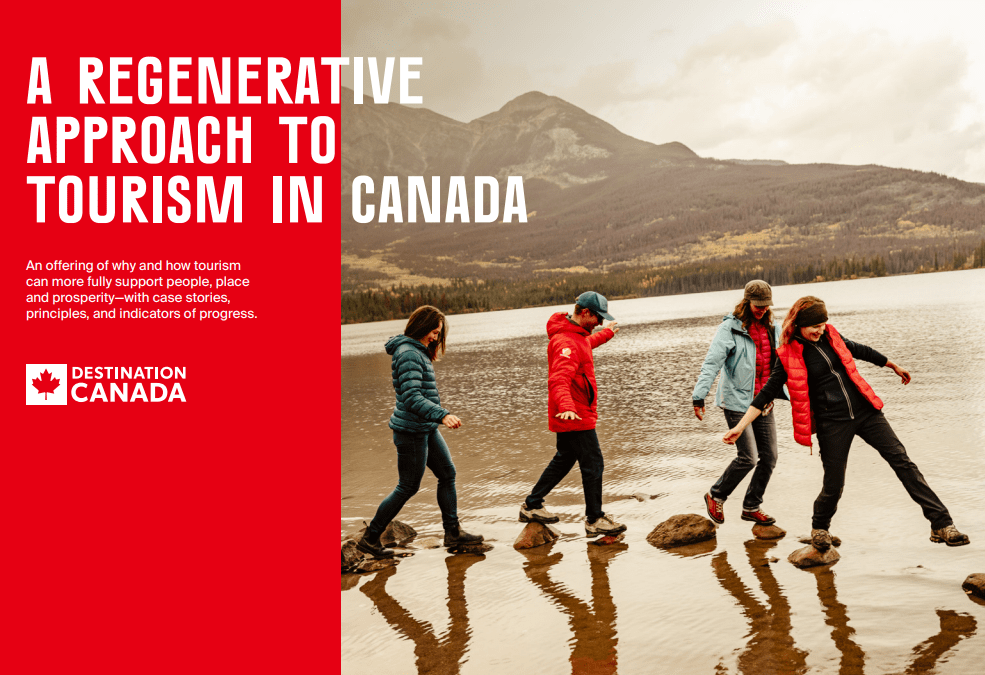
A Regenerative Approach to Tourism in Canada
Destination Canada
A detailed framework for why and how tourism can more fully support people, place, and prosperity in Canada, with case stories, principles, and indicators of progress providing inspiration for destinations beyond.